

Why Office Shuttle Services Can Be More Valuable Than a Higher Travel Allowance?

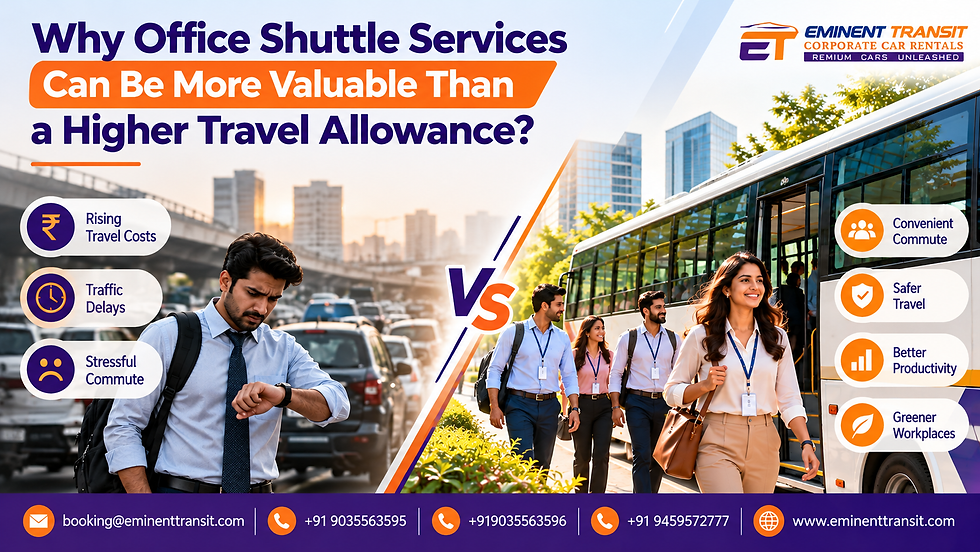
For HR leaders, facilities managers, and corporate decision-makers, employee commuting is more than a transportation expense. It influences punctuality, employee satisfaction, workplace productivity, and operational efficiency. While increasing travel allowances provides financial support, it does not necessarily solve daily commuting challenges such as traffic congestion, unreliable employee transportation and safety concerns.
Office Shuttle services offer a structured alternative by combining organised transportation, cost management and a more predictable commuting experience. For businesses with large workforces, multiple shifts or employees travelling along similar routes, an employee shuttle service can deliver value beyond a monetary benefit.
Why Office Shuttle Services Make Better Business Sense
A higher travel allowance leaves employees responsible for arranging their own transportation. An office shuttle service enables companies to coordinate pickups, plan routes and manage transportation around workforce requirements.
Key business benefits include:
Cost management: Plan transportation expenditure around demand and vehicle capacity.
Improved punctuality: Coordinate pickups with office hours and shift schedules.
Employee convenience: Reduce the burden of arranging daily transportation independently.
Centralised monitoring: Track journeys and transport performance.
Safety management: Establish driver verification, vehicle maintenance and emergency response procedures.
The value depends on employee locations, route efficiency, vehicle occupancy and the cost of alternative commuting arrangements.
Employee Travel Costs and Traffic Congestion: Why Smarter Commuting Matters
Commuting expenses affect employees differently depending on their location and transport requirements. According to India's National Household Travel Survey, conducted between July 2025 and June 2026, the average monthly expenditure on travel to fixed workplaces was ₹785 per worker, rising to ₹1,044 for urban workers. The findings were released in October 2026 by the Ministry of Statistics and Programme Implementation.
Traffic congestion adds another challenge. The TomTom Traffic Index 2025 reported an average congestion level of 74.4% in Bengaluru, with a 10-kilometre journey taking an average of 36 minutes and 9 seconds.
These figures demonstrate why businesses should evaluate commuting as part of their workforce strategy. An organized employee shuttle service can consolidate journeys, coordinate arrival times and help companies plan transport capacity around actual demand.
Employee Shuttle Service vs Higher Travel Allowance
Both options have advantages, but they serve different business needs.
Business factor | Higher travel allowance | Employee shuttle service |
Employee flexibility | High | Depends on routes and schedules |
Cost planning | Depends on policy and reimbursements | Supports contracted budgeting |
Commute coordination | Individual responsibility | Centralised management |
Punctuality | Limited direct control | Scheduled pickups |
Safety oversight | Depends on individual arrangements | Defined transport protocols |
Travel allowances may suit employees with varied commuting requirements. However, companies with concentrated employee locations, fixed shifts and common routes may benefit more from organized employee transportation. A hybrid model can accommodate employees who cannot access designated shuttle routes.
How Office Shuttle Services Improve Productivity and Safety
A planned shuttle programme can use route optimisation, GPS tracking, scheduled boarding points and centralised dispatch to improve transport visibility. Although it cannot eliminate traffic congestion, it can help businesses coordinate arrivals and manage delays more effectively.
Reliable employee travel for a better workday
Employees travelling as passengers may avoid the stress of driving through traffic, potentially improving their commuting experience. Businesses can also establish safety measures such as verified drivers, regular vehicle inspections, journey monitoring and emergency escalation procedures.
For night-shift operations, additional safeguards such as SOS alerts, panic buttons and monitored drop-off protocols can strengthen employee safety.
Shared transportation can also support sustainability objectives when efficient routes and suitable occupancy reduce the number of individual vehicles required. Actual environmental benefits depend on vehicle type, occupancy and the journeys being replaced.
How Eminent Transit Supports Corporate Employee Transportation
Choosing the right transportation partner is essential for businesses implementing an office shuttle program.
Eminent Transit provides corporate employee transportation services in Bangalore, including employee shuttle services, airport transfers, employee day outings and outstation transportation. Its published service information highlights intelligent route planning, GPS tracking, maintained vehicles and professional drivers.
The company also highlights women's safety measures, including GPS monitoring, SOS and panic-button alerts, a 24/7 Central Command Center, verified drivers and security escorts for designated night-shift journeys.
These capabilities can help businesses establish a more structured approach to employee mobility, particularly when reliable scheduling, employee safety and centralised transport management are priorities.
Before implementing a programme, organisations should assess employee locations, shift timings, route feasibility and expected vehicle occupancy. Tracking cost per employee, punctuality, vehicle utilisation and employee satisfaction helps determine whether the service delivers measurable business value.
Conclusion: Invest in Better Commutes, Not Just Bigger Allowances
A higher travel allowance provides financial flexibility, but an Office Shuttle service can address broader commuting challenges when workforce demand and route planning support shared transportation.
Businesses should prioritise:
Cost efficiency: Align transport spending with actual demand.
Employee experience: Improve commuting convenience and predictability.
Operational productivity: Coordinate pickups and shift schedules.
Safety and sustainability: Establish monitoring and responsible shared-mobility practices.
Measurable ROI: Compare total costs, utilisation and employee feedback.
With tailored corporate transportation solutions, Eminent Transit helps businesses explore a more reliable and structured approach to employee commuting. The goal is to move beyond reimbursement-led thinking and build a corporate mobility strategy that benefits both employees and employers.


Comments